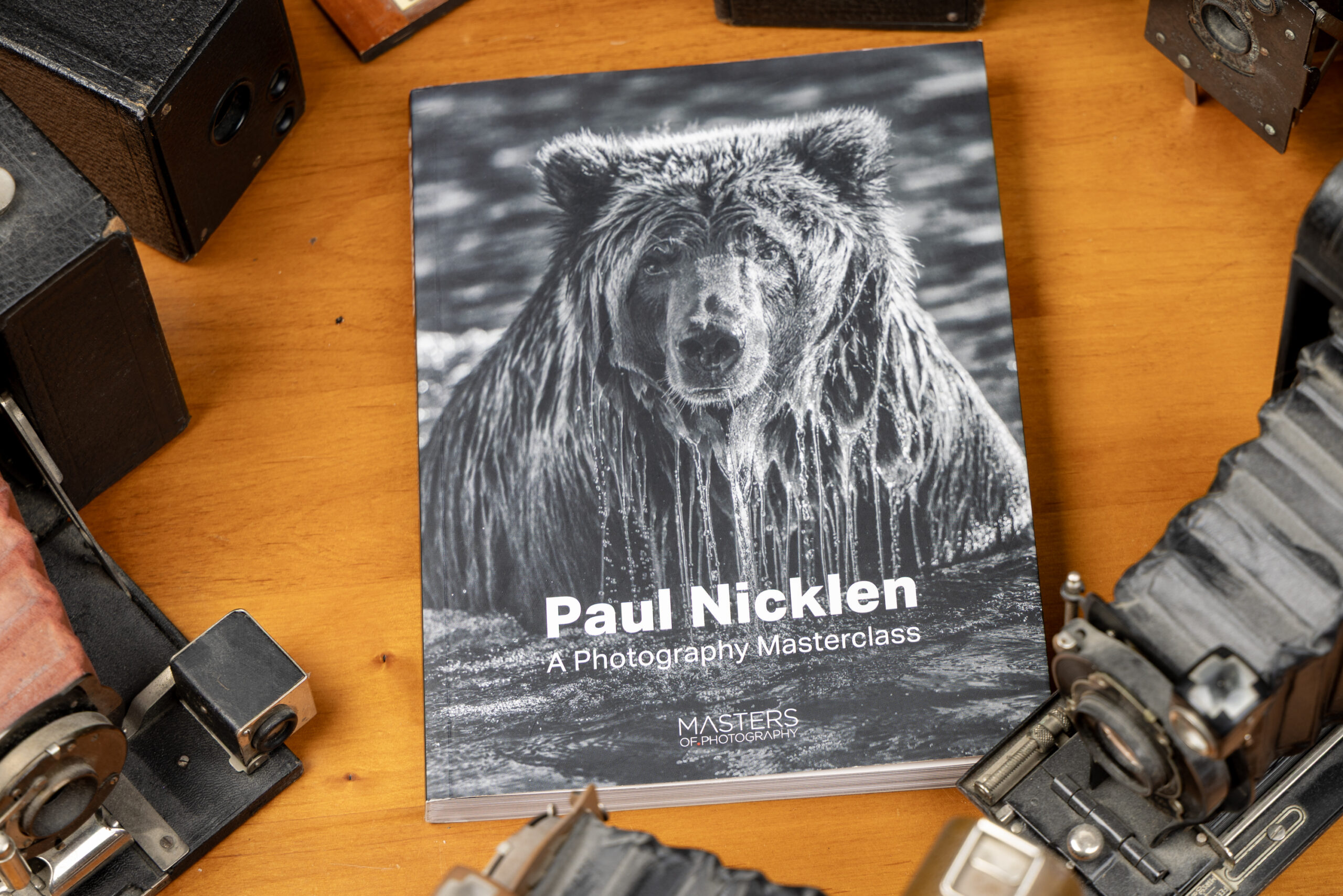
Paul Nicklen: A Photography Masterclass (Masters of Photography Series)
Over the past several years “workshop” books have become popular. The Aperture Foundation, which has a long history of promoting photography as art, jumped into the genre several years ago.
Over the past few years, the video series “Masters of Photography” has joined the game with four titles featuring Joel Meyerowitz, Albert Watson, David Yarrow and now, Paul Nicklen.
Although the books are cross-promoted with the video series, they are stand-along volumes and it’s not necessary to purchase the videos to appreciate and benefit from the books. Honestly, the videos are pricey and I’m not one to sit through multiple hours of video instruction – especially when I could be out shooting pictures instead.
Most of these books, regardless of publisher or author, tend to follow a fairly standard formula that combines biography, inspirational and aspirational advice, practical tips and a selection of the photographer’s work.
I feel the main value of these series arises from being able to purchase a nice selection of the photographer’s work at a cost that is usually far below what one would pay for a larger format portfolio book. It’s also a great introduction to photographers that you may not be familiar with.
If you are interested in sampling a variety of work from several different photographers, these series offer an affordable way to do that – especially when combined with some of the other lower cost portfolio series such as Thames & Hudson’s extensive Photofiles and Aperture’s own Masters of Photography.
Those two series tend to concentrate on iconic photographers like Paul Strand, Robert Frank, Dorothea Lange, Sebastiao Salgado and Andre Kertesz.
The four books to date in the Masterclass/Masters of Photography series consist of two other icons, Watson and Meyerowitz, along with the lesser-known nature photographers Yarrow and Nicklen.
As a side note, the “Masters” series has a new publisher, Frances Lincoln, and has been revised to offer a slightly larger format while maintaining the same high-quality printing.
Nicklen is a National Geographic photographer and his work tends to have a slightly more journalistic bent than Yarrow, who does quite a bit of commercial work using animals, as well as more traditional wildlife photography.
(Read my earlier review of the Yarrow Book)
Nicklen’s book, like the others, is broken down into bite-sized chapters (20 chapters in less than 200 pages) covering various topics like: What kind of photographer are you?; A roadmap to success; Inside Paul’s kitbag; The art of storytelling; Ethical considerations; The art of editing; The business of photography; and The role of social media.”
Nicklen grew up on remote Baffin Island in the far north east of Canada, a region that is closer to Greenland than it is to many parts of Canada. Although his mother was an avid photographer, Nicklen writes that growing up he never thought he would take up photography.
In college, he moved across country to study biology at the University of Victoria in British Columbia. He began his career as a biologist, but while still in his twenties he decided to try to transition to photography with a goal of working for National Geographic. An ambitious goal that he achieved through perseverance and constant honing of specific skills, such as scuba diving, as well as an intimate knowledge of wildlife accumulated through his upbringing and education.
Nicklen has led an interesting life and he offers well-reasoned advice throughout the book, but honestly, I find that these sorts of “career-coaching” books can blend together after you’ve read a few. Most can be summed up through some combination of “set a goal, hone your technical skills, find inspiration wherever you can, work hard, network with others whenever possible, keep trying even if you fail, and find creative ways to market yourself.”
All good advice for any field. But since these books are written by people who have found success in their careers one gets a feeling that they are often a bit too optimistic. Just as history is written by the victors, career advice is given by the successful. After all, no one wants to buy a book that advices that you can work hard, nurture your skills and exhibit great talent and still not succeed, even if the odds show that is often the case.
In Nicklen’s case it’s worth acknowledging that he found a way to take what many would find to be the nearly insurmountable challenges of growing up in an isolated and very hostile environment and used that experience to develop a marketable skill set. In some ways, it’s a reminder that the best route to success can be to identify what your unique skills, knowledge and interests are and fine tune that to make yourself a valuable asset to an organization.
Over the years, as I’ve read about photographers, I’ve often found that an often-unacknowledged fact is that many of history’s most renowned photographers had the luxury of inherited wealth or profitable marriages. Henri Cartier-Bresson was the scion of one of France’s most successful thread manufacturers. Alfred Stieglitz’s father was a successful wool merchant who could afford to summer at a Lake George estate. The father of Walker Evans was a successful advertising director enabling Walker to attend prestigious Phillips Academy in Andover, Massachusetts, study French literature at Williams College and spend a year in Paris in his twenties.
Nicklen is an exception. He seems to have clawed his way to success by a combination of gritty determination, single-mindedness and making the most of opportunities that presented themselves. Plus, his willingness to endure some of the most extreme conditions on earth has helped him get photographs that few others could capture.
I don’t know that Nicklen’s path to success is one that can be easily replicated. But, his is an inspiring story. His book contains some good practical tips and most of all it is filled with well-printed inspiring photographs.
Ultimately, the main value of any book of photographs is to inspire by learning from the images themselves. The quality and quantity of photographs makes this book a worthwhile investment for anyone interested in improving their wildlife photography.
Paul Nicklen: A Photography Masterclass on Amazon
David Yarrow: How I Make Photographs (Masters of Photography) on Amazon
Albert Watson: Creating Photographs (Masters of Photography) on Amazon
Joel Meyerowitz: How I Make Photographs (Masters of Photography) on Amazon
Aperture Photography Workshop Series on Amazon
Aperture Masters of Photography Series on Amazon
Thames & Hudson’s Photofile Series on Amazon
Using these Amazon Links when buying books helps support this website. Thank You!